
Enlarged Prostate (BPH) Treatment Without Surgery in Delhi
Prostate Artery Embolization (PAE) shrinks the enlarged prostate through a pinhole — no cut, no general anaesthesia, and usually home in about a day.
- No surgical cut or stitches
- Done under local anaesthesia
- Usually ~1 day hospital stay
- Low risk to sexual function

Sir Ganga Ram HospitalDept. of Interventional Radiology
EBIR CertifiedEuropean Board of Interventional Radiology
Vice-President, ISVIRIndian Society of Vascular & IR
IR practice since 2006Founded the IR dept. at SGRH
Are these urinary problems affecting your life?
Benign Prostatic Hyperplasia (BPH) is a non-cancerous enlargement of the prostate that is very common in men over 50. The enlarged gland squeezes the urine passage and causes:
- 1Waking up 2 or more times at night to urinate
- 2Frequent or urgent need to urinate
- 3Weak, slow or interrupted urine stream
- 4Difficulty or straining to start urination
- 5Feeling the bladder is not completely empty
- 6Dribbling or leakage after urination
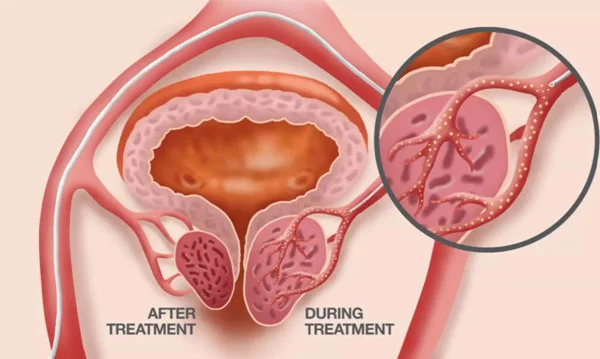
What is Prostate Artery Embolization (PAE)?
PAE is a minimally invasive procedure performed by an interventional radiologist. Instead of cutting or removing prostate tissue, it reduces the blood supply to the enlarged prostate so that the gland shrinks naturally.
It is a good option for men who are not getting relief from medicines, want to avoid surgery, are at higher risk from anaesthesia, or have a very large prostate.
Check if PAE suits youConsultation & tests
Dr. Gupta reviews your symptoms, ultrasound/MRI of the prostate, PSA and blood tests to confirm PAE is right for you.
Pinhole access
Under local anaesthesia, a thin catheter is placed through a tiny puncture in the groin or wrist artery — no surgical cut.
Blocking the prostate arteries
Using X-ray guidance, microscopic particles are placed in the arteries feeding the prostate, on both sides.
Prostate shrinks, symptoms ease
With reduced blood supply the enlarged prostate gradually softens and shrinks, relieving pressure on the urethra.
How PAE compares with conventional prostate surgery
A general comparison — your doctor will advise what suits your prostate size and health.
| PAE (Embolization) | Conventional Surgery (TURP) | |
|---|---|---|
| Anaesthesia | Local anaesthesia, patient awake | Spinal or general anaesthesia |
| Incision / cut | Tiny pinhole in groin or wrist artery | Instrument passed through the urethra |
| Hospital stay | Usually about 1 day | Usually several days |
| Urinary catheter after | Usually not needed | Usually needed for some days |
| Sexual function | Low risk of retrograde ejaculation | Retrograde ejaculation is common |
| Back to routine | Usually within a few days | Usually a few weeks |
Individual results and recovery vary. PAE is not suitable for every patient.
Who can benefit from PAE?
PAE may be right for you if
- You have moderate to severe urinary symptoms due to BPH
- Medicines are not helping or cause side effects
- You want to avoid surgery or have been advised TURP
- You have a large prostate or are on a urinary catheter
- Heart, lung or other conditions make surgery risky
These need to be ruled out first
- Prostate cancer
- Active urinary tract infection or prostatitis
- Bladder stones
- Neurogenic bladder or urethral stricture
- Significant kidney insufficiency
Dr. Arun Gupta
- Established the Department of Interventional Radiology at Sir Ganga Ram Hospital in 2006
- Super-specialisation training in Interventional Radiology at SGPGI, Lucknow
- Vice-President, Indian Society of Vascular & Interventional Radiology (ISVIR)
- Member, Asia Pacific Society of Cardiovascular & Interventional Radiology
- Numerous publications and national & international guest lectures
Quick procedure, quick recovery
Typical experience for patients undergoing PAE at Sir Ganga Ram Hospital.
Success rate as reported by the department. Results vary between patients; mild temporary side effects such as burning urination can occur.
Common questions about PAE for enlarged prostate
What is Prostate Artery Embolization (PAE)?
PAE is a minimally invasive, non-surgical treatment for an enlarged prostate (BPH). An interventional radiologist blocks the small arteries supplying the prostate through a pinhole in the groin or wrist, so the prostate shrinks and urinary symptoms improve.
Is PAE painful?
PAE is done under local anaesthesia through a needle puncture, so there is no surgical cut. Some patients feel mild discomfort or burning while urinating for a few days, which is managed with medicines.
How soon will my symptoms improve?
Many patients notice improvement within days to a few weeks, and the prostate continues to shrink over the following months. Results vary from person to person.
Who is a good candidate for PAE?
Men with moderate to severe urinary symptoms due to BPH, those not improving on medicines, those who wish to avoid surgery or are at higher risk from surgery, and those with very large prostates. Prostate cancer, active urinary infection, bladder stones, neurogenic bladder and urethral stricture need to be ruled out first.
How long is the hospital stay?
The typical hospital stay is about one day, and most patients can return to light routine work soon after, depending on their overall health.
Does PAE affect sexual function?
PAE does not involve cutting prostate tissue, so the risk of retrograde ejaculation and erectile problems is low compared with conventional surgery. Dr. Gupta will discuss your individual risks during consultation.
What are the possible side effects?
Reported side effects are usually mild and temporary — burning while urinating, urinary infection, traces of blood in urine, temporary urine retention or minor rectal bleeding. Your team monitors you closely after the procedure.
Where is PAE done in Delhi?
PAE is performed by Dr. Arun Gupta and the Interventional Radiology team at Sir Ganga Ram Hospital, Old Rajinder Nagar, New Delhi.
Advised prostate surgery? Get a second opinion.
Speak to Dr. Arun Gupta's team about non-surgical PAE.